

Children begin developing the ability to manage their emotions early in life, although some benefit from more support and guidance on how to do this than others, contributing to inequalities in socio-emotional development[1], [2], [3].
Teaching children and young people developmentally appropriate ways to manage strong, unpleasant or uncomfortable emotions (or ‘difficult feelings’), such as disappointment, anger and frustration, can help them to stop such emotions from escalating and causing discomfort, disruption or distress.
Furthermore, research conducted in the UK has found that children who are better able to manage their emotions and problem solve during their first year of secondary school take part in fewer unhealthy behaviours and experience better mental health and wellbeing as teenagers [4], [5]. Similar findings have been reported in high-quality international research [6], [7], [8].
Fortunately, there are many evidence-based strategies that can be introduced during PSHE education that can help children and young people to learn how to manage their emotions.
Taking a few slow breaths, or ‘slow breathing’, is a simple technique that can be used to reduce the intensity and duration of strong, unpleasant or uncomfortable emotions, such as excitement, anger and apprehension. If practised effectively, it can facilitate physiological changes that activate our parasympathetic (‘rest and digest’) nervous system, helping us to feel calmer and more in control. This, in turn, can help us to relax, think more clearly and resolve problems. And because slow breathing can be practised across a wide range of situations — often without others noticing — it can be an especially versatile and empowering tool.
Whether joining a new school, performing in a show, competing in an event, or taking a test [9], children and young people may find slow breathing especially useful in helping them to navigate these situations and manage uncomfortable emotions.
While it is not unusual to encourage children to ‘take a deep breath’ when they are feeling upset, it has been found that children sometimes find it difficult to intuitively grasp how to practice slow breathing effectively.
Often, they either take excessively deep breaths or too few slow breaths. However, it has been found that clear instructions and visual aids can support young children to practice slow breathing safely and effectively [10], [11].
In research published in Developmental Psychobiology, a peer-reviewed journal, Stanford University researchers reported that when they showed a brief animated guide to slow breathing to 5- to 12-year-old children in naturalistic settings, such as playgrounds and museums, it led to significant reductions in their biomarkers of stress. The animated guide used calming visualisations to scaffold and support children to take several slow breaths over the course of 60 seconds.
What makes the research published in Developmental Psychobiology high quality?
|
That’s why we developed a free animated guide to slow breathing (with BSL also available) as part of Foundations for Wellbeing — our new mental health and wellbeing curriculum.
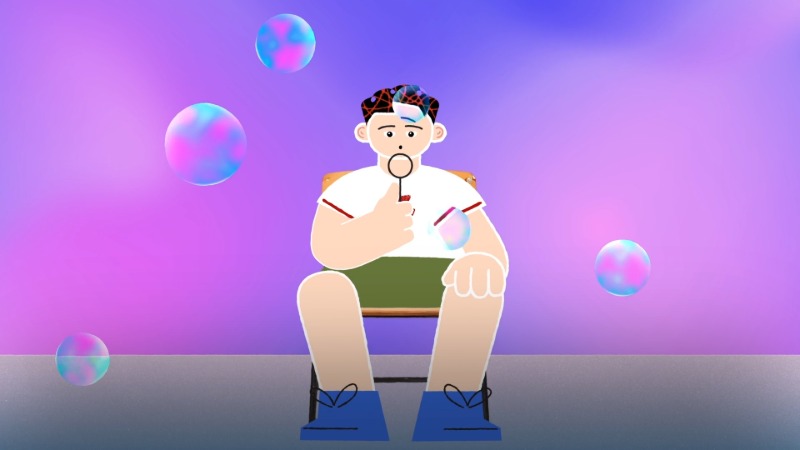
Teachers, parents, carers and other adults can use this animated guide to introduce primary school children to slow breathing. In the guide, children are encouraged to breathe in slowly as though smelling a flower, and to breathe out slowly as though gently blowing soft bubbles. We’ve designed the visualisations to be calming and to help children remember how to use slow breathing to manage their emotions across a range of situations.
The guide can also be shared with secondary school students, who can use it outside of classroom settings if they wish to.
|
|

Older children can be introduced to a variation of slow breathing that involves extending the outbreath slightly (e.g., by breathing in to a count of four and out to a count of five) — helping to slow the heartrate and activate the parasympathetic nervous system more efficiently [13].
We developed a separate animated guide to progressive muscle relaxation (also free), which builds on the animated guide to slow breathing and encourages primary school children to gently tense and release different muscle groups, one at a time. Contrary to common misconceptions, progressive muscle relaxation can also be used in public, as it can be practised subtly, without others noticing.
Like slow breathing, progressive muscle relaxation can help us to relax and release tension that can naturally build over the course of the day, especially when we’ve had to negotiate several challenging or frustrating tasks.
Primary school children may find progressive muscle relaxation especially helpful towards the end of the school day, after doing challenging or frustrating schoolwork, or after breaktime (when a lot of energy may have built up). Secondary school students might find helpful after returning home from school or doing difficult homework.
Research conducted in England, and funded by the Department for Education, has found that leading brief (~5-minute) relaxation techniques regularly and consistently can support primary school children’s mental health and wellbeing by reducing emotional difficulties [11]. These can therefore sit alongside and complement dedicated and contextualised learning about emotions that takes place during PSHE education*.
At the PSHE Association, we believe that children and young people should be entitled to learn strategies that can help them to manage their emotions and progress towards achieving personally meaningful, self-endorsed goals.
Slow breathing and progressive muscle relaxation are two of many strategies that they may find useful in helping them to do this, although it is important to note that neither will work (a) for all children**, and/or (b) across all situations.
That’s why Foundations for Wellbeing and Wellbeing for Life introduce a wide range of emotion regulation strategies, enabling children and young people to learn about them and situations in which they may be most helpful during dedicated lessons. Children can then reflect on them before carefully experimenting with them in their day-to-day life.
Learn more about Foundations for Wellbeing (EYFS-KS2)
Learn more about Wellbeing for Life (KS3-4)
And remember, children and young people should always be reminded that if they are experiencing thoughts or emotions that are making it difficult for them to do things that they care about, enjoy or need to do, they should seek support from a trusted adult, such as a teacher, parent, carer or other family member.
Next time, we will turn our focus to distraction and consider how it can be both used and managed, depending on the situation.
*Regularly leading relaxation techniques with entire classes was associated with higher emotional difficulties among secondary school students [11]. This means that, while individual secondary school students may find using relaxation techniques helpful, and can be introduced to them during PSHE education lessons, encouraging entire classes of secondary school students to practise them regularly is not recommended.
**Please note that some children may find focusing on their breathe or bodily sensations uncomfortable. If this is the case, reassure them and support them to try a different emotion regulation strategy, such as focusing their attention on an activity that they enjoy (e.g., drawing).
[1] Lucas, M., Bocock, L., Del Pozo Segura, J.M. & Hillary, J. (2025). International comparisons: Investigating cross-country differences in young people’s skill development and identifying factors associated with high-performance. Working paper 7 of The Skills Imperative 2035: Essential skills for tomorrow’s workforce. Slough: NFER.
[2] O’Connor, M., Arnup, S. J., Mensah, F., Olsson, C., Goldfeld, S., Viner, R. M., & Hope, S. (2022). Natural history of mental health competence from childhood to adolescence. Journal of Epidemiology & Community Health, 76(2), 133-139.
[3] van Poortvliet, M. (2021). Inequality in skills for learning: do gaps in children’s socio-emotional development widen over time according to family background? Oxford Review of Education, 47(4), 455-474.
[4] Lereya, S. T., Patalay, P., & Deighton, J. (2022). Predictors of mental health difficulties and subjective wellbeing in adolescents: A longitudinal study. JCPP Advances, 2(2), e12074.
[5] Rougeaux E, Hope S, Viner RM, Deighton J, Law C, Pearce A. (2020) Is mental health competence in childhood associated with health risk behaviors in adolescence? Findings from the UK Millennium Cohort Study. Journal of Adolescent Health, 67(5), 677-684.
[6] Klinge, J. L., Warschburger, P., Busching, R. & Klein, A. M. (2023). Self-regulation facets differentially predict internalizing symptom trajectories from middle childhood to early adolescence: a longitudinal multimethod study. Child and Adolescent Psychiatry and Mental Health, 17(120).
[7] Moffitt, T. E., Arseneault, L., Belsky, D., Dickson, N., Hancox, R. J., Harrington, H., Houts, R., Poulton, R., Roberts, B. W., Ross, S., Sears, M. R., Thomson, W. M., & Caspi, A. (2011). A gradient of childhood self-control predicts health, wealth, and public safety. Proceedings of the National Academy of Sciences of the United States of America, 108(7), 2693-2698.
[8] Robson, D. A., Allen, M. S., & Howard, S. J. (2020). Self-regulation in childhood as a predictor of future outcomes: A meta-analytic review. Psychological Bulletin, 146(4), 324-354.
[9] Putwain, D. (2025). Effective coping with exam pressure. Leicester: British Psychological Society.
[10] Obradović, J., Sulik, M. J., & Armstrong-Carter, E. (2021). Taking a few deep breaths significantly reduces children’s physiological arousal in everyday settings: Results of a preregistered video intervention. Developmental Psychobiology, 63(8), e22214.
[11] Deighton, J., Thompson, A., Humphrey, N., Thornton, E., Knowles, C.,Patalay, P. Zhang, K., Evans-Lacko, S., Hayes, D., March, A., Mansfield, R., Santos, J., Deniz, E., Stallard, P., Ashworth, E., Moltrecht, B., Nisbet, K., Stapley, E., Mason, C., Stepanous, J., & Boehnke, J. R. (2025). Effectiveness of school mental health and wellbeing promotion: Universal approaches in English primary and secondary schools. Department for Education.
[12] Gross, J. J. (2015). The extended process model of emotion regulation: Elaborations, applications, and future directions. Psychological Inquiry, 26(1), 130–137.
[13] Dorjee, D. (2025). Making sense of mental health and wellbeing in primary schools: A practical, neuroscience-based guide. London: Routledge.